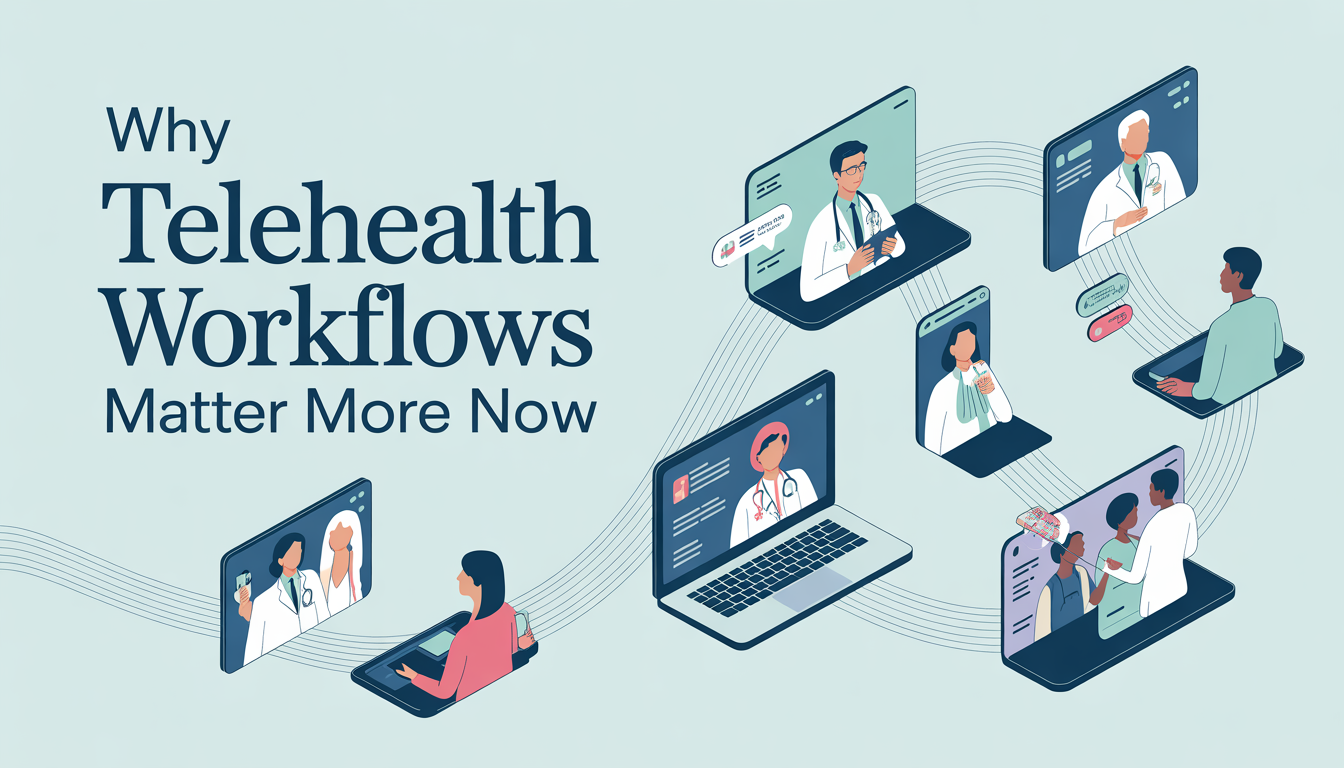
In the early days of the pandemic, telehealth was a frantic necessity. We slapped together video calls and digital forms just to keep the lights on. But the “duct-tape” era of digital health is over. Today, a doctor simply showing up on a screen isn’t enough to sustain a practice or provide high-quality care.
The reason most digital health initiatives struggle today isn’t because the technology is bad; it’s because the workflow is broken. A workflow is the “invisible plumbing” of healthcare, the sequence of steps that move a patient from a symptom to a solution. If the plumbing is clogged, it doesn’t matter how fancy the faucet is.
The “Friction” Problem in Modern Medicine:
In a traditional clinic, the workflow is physical and intuitive. You walk in, the receptionist sees you, the nurse leads you to a room, and the doctor enters. The physical space dictates the flow. In telehealth, that physical “gravity” is gone.
Without a rigorous digital workflow, telehealth becomes a chaotic mess of missed links, forgotten patient histories, and “technical difficulties.” When a doctor has to spend six minutes of a ten-minute appointment playing IT support or hunting for a PDF that was supposed to be uploaded, the care suffers. We are seeing a massive “Cognitive Drain” on providers who are being forced to navigate clunky, non-linear systems.
1. Pre-Visit Integration: The “Waiting Room” of the Future:
The most critical part of a telehealth workflow happens before the video even starts. In an optimized system, the “Intake” is automated and intelligent.
Instead of a generic PDF, patients interact with a dynamic interface that collects their symptoms, updates their medication list, and, most importantly, verifies their insurance in real-time. This data must flow directly into the Electronic Health Record (EHR). If the doctor has to manually re-type information from a chat box into the medical record, the workflow has failed.
A seamless pre-visit workflow ensures that when the camera turns on, the doctor is already “briefed.” They aren’t looking at a stranger; they are looking at a data set that allows them to be a healer rather than an administrator.
2. The “Asynchronous” Advantage:
One of the biggest shifts in healthcare is the realization that not everything needs to be a live video call. High-performance workflows now incorporate Asynchronous Care, which enables patients to send data, photos, or messages that the doctor reviews at their own convenience.
This “Batching” of care is a game-changer for provider burnout. A doctor can review twenty skin rash photos in the time it takes to conduct three live video consultations. By building a workflow that triages patients into “Live” vs. “Asynchronous” buckets, clinics can see more patients without increasing the stress on the staff. The workflow acts as a filter, ensuring that the most complex cases get the face-to-face time they deserve.
3. Closing the Loop: The Post-Visit Handshake:
The “Black Hole” of telehealth is often what happens after the “End Call” button is pressed. In a physical office, you walk out past the pharmacy counter or the scheduling desk. In telehealth, the patient is often left staring at a blank screen, wondering, “What now?”
A robust workflow automates the “After-Care.”
- The Prescription: Sent instantly to the pharmacy via e-prescribing.
- The Summary: A plain-language summary of the visit pushed to the patient’s portal.
- The Follow-up: An automated “Check-in” message sent three days later to see if the symptoms have improved.
When these steps are “Baked into the System,” the patient feels cared for, even though they never left their couch. This “Loop Closure” is what builds trust in a digital-first world.
Why “Legacy” Workflows are Dangerous:
The biggest mistake healthcare leaders make is trying to force “In-Person” logic into a “Digital” space. You cannot simply take a paper form and turn it into a digital fillable PDF and call it “Innovation.”
Digital-native workflows allow for Parallel Processing. While the patient is waiting in the “Virtual Lobby,” the system can be checking for potential drug interactions or identifying gaps in their preventative care (like an overdue flu shot). A legacy workflow is linear; a modern telehealth workflow is multi-threaded.
Conclusion:
In 2026, patients aren’t choosing doctors based on who has the best video quality. They are choosing based on who makes the experience the “Easiest.” They want the frictionless “Amazon” experience applied to their heart health or their child’s fever.
Telehealth workflows matter more now because the novelty of digital care has worn off. We are no longer impressed that we can see a doctor on a phone; we are frustrated if that experience is clunky, slow, or disconnected. The practices that survive the next decade will be the ones that stop obsessing over the “Tele” and start mastering the “Work.”
FAQs:
1. What is “Triage Automation” in telehealth?
It’s a system that uses a patient’s initial input to decide if they need an emergency room, a live video call, or just a quick text-based answer.
2. How do workflows reduce “Provider Burnout”?
By removing the “Administrative Burden.” A good workflow handles the scheduling, billing, and data entry, letting the doctor focus purely on the patient.
3. What is “EHR Interoperability”?
It’s the ability for your telehealth software to “Talk” to your main hospital database. Without this, your medical history is fragmented and dangerous.
4. Can a bad workflow lead to medical errors?
Yes. If the workflow is confusing, a doctor might miss a critical lab result or forget to send a prescription, simply because the system didn’t “Nudge” them to do it.
5. Why is “Asynchronous” care becoming so popular?
Because it’s more convenient for the patient (no waiting for a specific appointment time) and more efficient for the doctor.
6. Does a better workflow actually save money?
Absolutely. It reduces “No-Show” rates, minimizes staff time on the phone, and allows a single clinic to handle a much larger volume of patients.