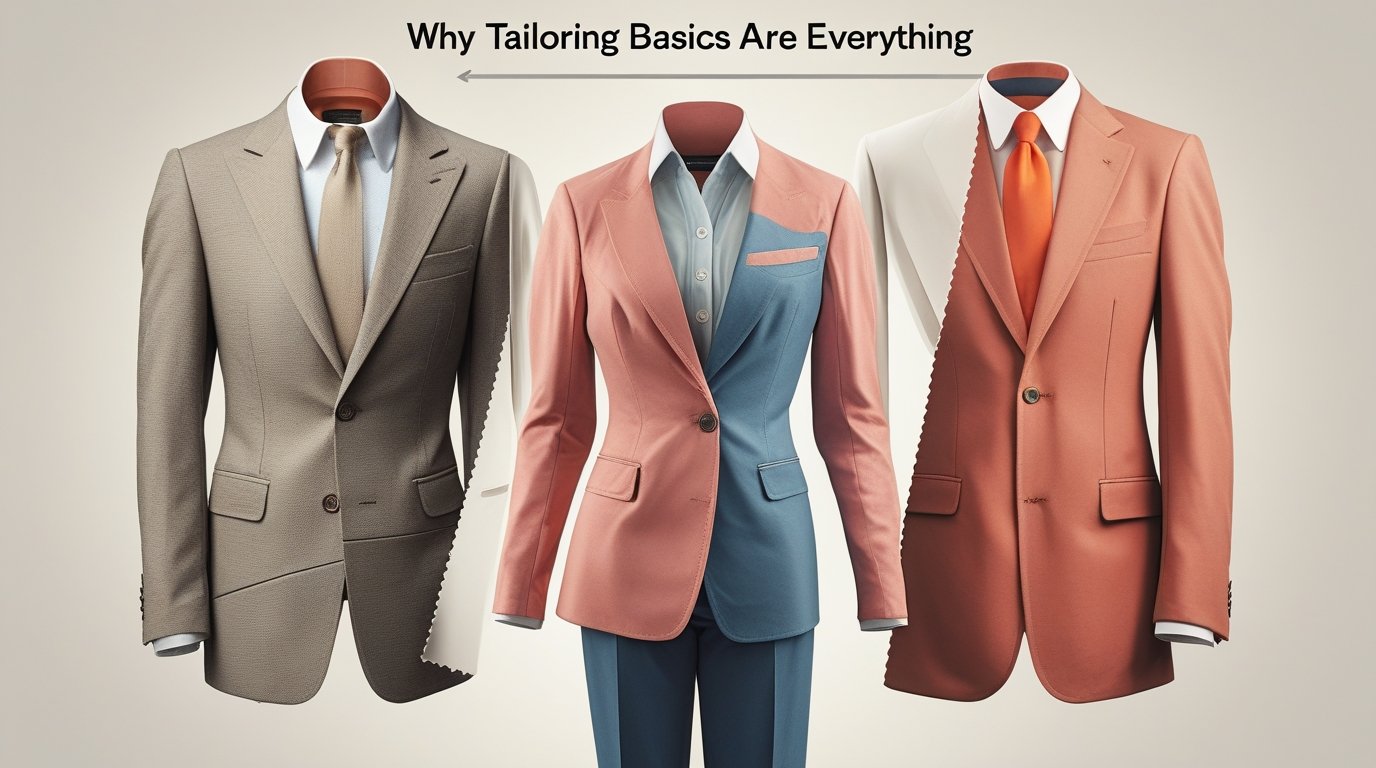
I once bought a “Standard Large” white t-shirt that fit me so poorly I looked like a sail that had lost its boat. The shoulder seams were hanging halfway down my biceps, and the hem reached so low I could have technically called it a mini-dress. I looked less like a “fashion influencer” and more like a kid who had survived a laundry room explosion. Then, I spent $12 at a local tailor to have the sides taken in and the sleeves shortened. Suddenly, people were asking if I’d started working out. I hadn’t; I just stopped wearing a tent. If you think your wardrobe needs more clothes, you’re wrong, it just needs a sewing machine or a guy named Luigi who knows his way around a measuring tape.
Part 1: The “Store-Standard” Lie:
The fashion industry works on a “Standard Sizing” model that is, quite frankly, a work of pure fiction. When a brand creates a “Medium” shirt, they aren’t designing it for you; they are designing it for a mathematical average of ten thousand people that doesn’t actually exist. They have to make the armholes big enough for a bodybuilder and the waist wide enough for a beer enthusiast, just to make sure the garment doesn’t get returned.
When you buy “Off-the-Rack,” you are buying a compromise. You are buying a piece of fabric designed to fit “mostly everyone,” which means it fits “perfectly no one.” Tailoring basics is the process of reclaiming your identity from the average. Whether it’s a $15 Hanes tee or a $200 pima cotton staple, the fabric doesn’t care about the price tag, it only cares about how it drapes over your specific skeletal structure.
I used to think tailoring was only for suits and wedding dresses. I was wrong. The most powerful tool in your style arsenal isn’t a designer logo; it’s the perfect fit. A tailored basic makes a cheap outfit look expensive, while an ill-fitting designer piece makes an expensive outfit look like a hand-me-down.
Part 2: The Geometry of the “Perfect” T-Shirt:
Let’s talk about the humble T-shirt. It is the most basic item in human history, yet 90% of people are wearing the wrong size. A t-shirt lives or dies by two specific points: the shoulder seam and the sleeve length.
- The Shoulder Seam: In a perfectly tailored basic, the seam where the sleeve meets the body should sit exactly on the “corner” of your shoulder bone. If it’s drooping down, you look slouchy and unathletic. If it’s pulling toward your neck, you look like you’re wearing a younger sibling’s clothes.
- The Sleeve Length: Most mass-produced sleeves are too long and too wide. They flare out like little wings, making your arms look like toothpicks. By tapering the sleeve and shortening it to hit the mid-bicep, you create the illusion of muscle and structure.
I started taking my basic crew necks to the tailor to have them “slimmed through the torso.” Most shirts are cut like boxes. Humans, generally, are not boxes. By adding two simple darts in the back or taking in the side seams, the shirt follows the natural “V” of your torso. This is proportional dressing at its finest. You aren’t changing your body; you’re just stopping the fabric from lying about it.
Part 3: Jeans and the “Original Hem” Secret:
Jeans are the backbone of the casual wardrobe, but they are also the most common victim of “The Stomp.” You know the look: someone wearing jeans that are three inches too long, so the bottom of the denim is shredded, dirty, and bunched up over their sneakers like an accordion.
When you get your jeans tailored, you need to know about the Original Hem. A lazy tailor will just cut the jeans and sew a new, flat, bright-orange-thread hem that looks fake and cheap. A great tailor will cut the “distressed” hem off, shorten the leg, and then reattach the original bottom.
This keeps the weight and the “wash” of the denim consistent. It changes the entire silhouette of the leg. When your jeans hit perfectly at the ankle (the “Ankle Gap” we discussed in previous articles), your legs look longer, and your shoes look cleaner. It turns a “dad jean” into a “designer fit” for the cost of a fancy burrito.
Part 4: Making “Cheap” Look “Couture”
The biggest secret of the fashion elite is that they don’t buy everything at Gucci. They buy basics at Uniqlo or Gap and then spend $20 to make them fit like they were custom-made in Italy.
This is the ROI (Return on Investment) of tailoring.
- The Button-Down: Have the “billow” removed from the lower back so it doesn’t “muffin top” over your belt.
- The Chinos: Taper the leg from the knee down. Mass-market pants are often too wide at the ankle, which makes you look shorter. A slight taper creates a streamlined, modern look.
- The Blazer: This is the big one. Even a cheap H&M blazer can look incredible if the sleeves are the right length (showing half an inch of shirt cuff) and the waist is nipped in.
I once bought a trench coat at a thrift store for $10. It was huge. It looked like I was two kids standing on each other’s shoulders under a tarp. I took it to my tailor, had the sleeves shortened and the belt loops moved up two inches to match my natural waist. I wore that coat to a high-end event and was complimented on my “vintage Burberry.” Tailoring is the ultimate life hack for the budget-conscious style enthusiast.
Part 5: The Psychological Boost of the “Second Skin”
There is a weird, almost magical confidence that comes with wearing clothes that actually fit. When you aren’t constantly pulling at your collar, tucking in a billowing shirt, or tripping over your pant cuffs, your body language changes. You stand taller. You move more fluidly.
When I wore ill-fitting basics, I felt like an imposter in my own clothes. I felt “sloppy.” The second I started auditing my fit, I felt “put together.” This isn’t vanity; it’s visual competence. People perceive you as more organized and professional when your clothes aren’t fighting your body. The “Human Factor” in fashion is that we respond to symmetry and intentionality. A tailored basic says, “I care about the details.” And if you care about the details of your shirt, people assume you care about the details of your work, too.
Conclusion:
Stop chasing the next “drop” or the latest trend. The most stylish thing you can ever wear is a plain white t-shirt and a pair of dark denim that fits you like a second skin. Tailoring your basics isn’t an “extra” expense, it’s the final step of the purchasing process. If it doesn’t fit, you haven’t finished buying it yet. Take your clothes to a professional, get pinned up, and discover the version of yourself that’s been hiding under all that extra fabric.
FAQs:
1. How much should I expect to pay to taper a shirt?
Usually between $15 and $25, depending on the complexity of the seams.
2. Can a tailor make a shirt bigger if it’s too tight?
Rarely, unless there is “extra” fabric in the seams, it’s much easier to take things in than let them out.
3. What is the “break” in trousers?
It’s the fold of fabric created when the bottom of your pant leg hits your shoe.
4. Should I wash my clothes before taking them to the tailor?
Yes, always pre-wash cottons and linens to account for any potential shrinkage before they are permanently altered.
5. How do I find a good tailor?
Ask a local high-end menswear or bridal shop who they use for their private alterations.
6. Is it worth tailoring a cheap $10 t-shirt?
Absolutely; a $10 shirt with $10 of tailoring looks better than a $100 shirt that fits poorly.